Monday, 15 July 2013

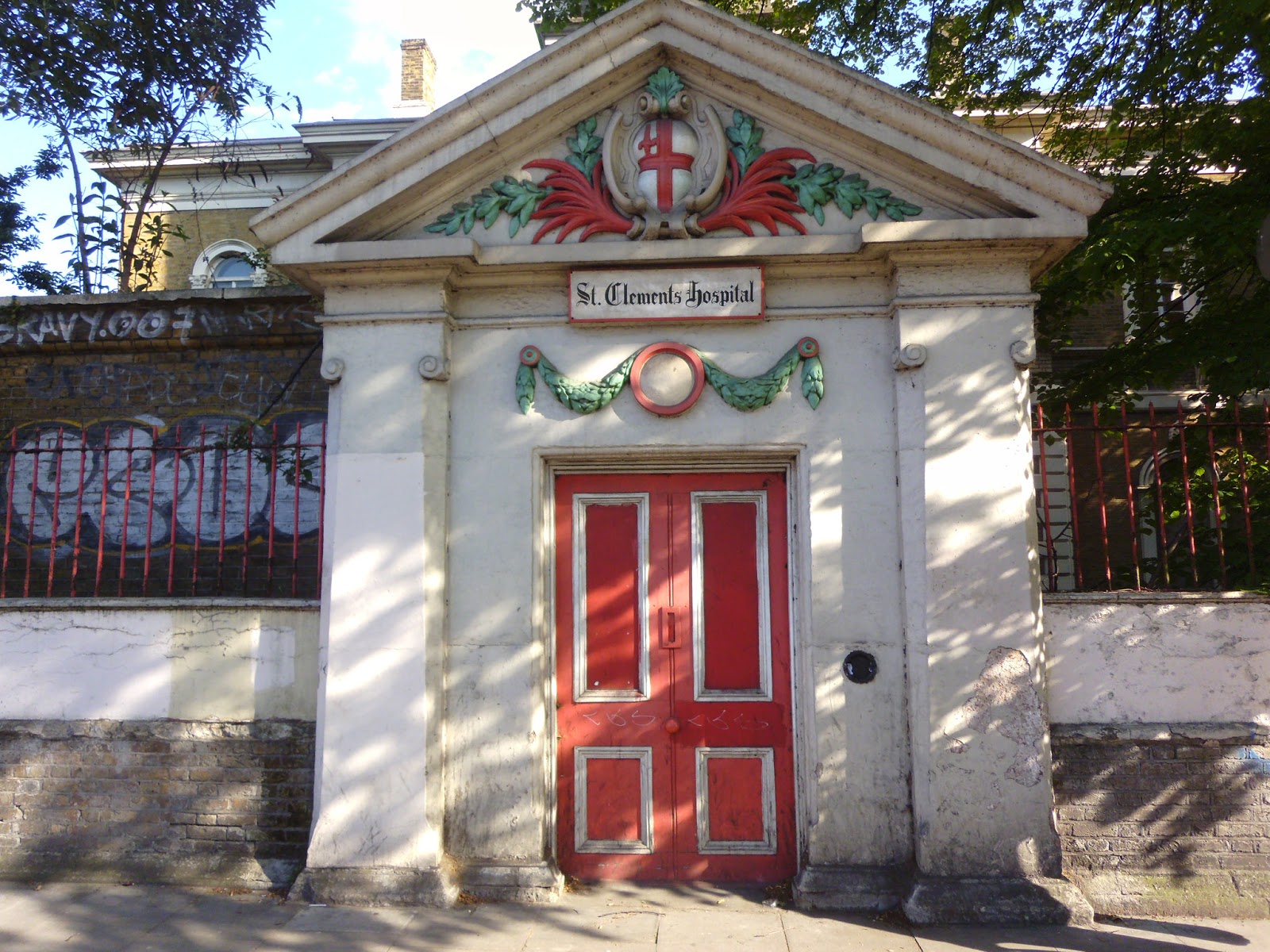
St Clements Hospital- vandals and nature have taken over the asylum.

The old historic entrance to the hospital, the buildings behind have been vandalised.
On a recent visit to Mile End Road I was shocked to see the state of dereliction St Clements Hospital has fallen into. The psychiatric hospital closed in 2005, with mental health services moving to a new purpose built facility at Mile End Hospital.

Once much effort went to keeping people in, now the focus is on keeping unwelcome visitors out.
St Clements began life as the City of London Union Workhouse in 1849. It was converted into an infirmary in 1874 and was renamed St Clements in 1936. It is a place that has witnessed immense suffering.
When training to be a psychotherapist I undertook the mandatory psychiatric observation placement in Tower Hamlets, dividing time between a community mental health setting shadowing staff working at Stepney and Wapping Community Mental Health Team and time in the acute setting of St Clements, spending time with staff and patients on a rehabilitation ward. Conditions in the hospital were very antiquated. The building felt very Dickensian, it was like stepping back in time. Locked fogged plastic windows added to the feelings of claustrophobia. Some patients had lived in the hospital for a very long time, and had become quite institutionalised.

Nature appears to be reclaiming the space, here ivy creeps over wrought iron railings.
Overall my sense was that this was a frightening depressing environment to be mentally unwell in. It was not an environment conducive to healing.

East London and The City Mental Health NHS Trust sold St Clements to the Homes & Communities agency, they plan to build 275 new dwellings on the site.

Tuesday, 2 July 2013

Brene Brown: the power and the beauty of vulnerability.


A friend sent me this link (highlighted below) to a talk on vulnerability by Brene Brown. Its one of 1,400 'creative commons' talks available on the TED website. TED for those who are not familiar with it was originally a conference held in the US- 'Technology, Entertainment, Design'. It's evolved and is now a major disseminator of ideas on the web.

These kinds of inspirational talks are something of an acquired taste, but this one touched me. Brown talks candidly about her life as a researcher, her attachment to the 'measuring stick', her research on shame, her psychotherapy and experience of breakdown/spiritual awakening. Its an uplifting talk though she doesn't explain how our need to defend and protect becomes so entrenched and habitual.

A funny, charismatic speaker, f you've ever struggled with vulnerability, experienced shame and fear loss of connection with others, you may find her talk interesting.

She names the main challenge-

Can we feel worthy of love and belonging?

Can we allow ourselves to be seen and be truly vulnerable?

Our vulnerability she reminds us is what makes us beautiful.
'Vulnerability is the birthplace of joy, creativity, belonging and love.'

Here's the link:
http://www.ted.com/talks/brene_brown_on_vulnerability.html

Friday, 31 May 2013

Jung on midlife: understanding the alchemy of life's midday. Don't dilly-dally on the way!

Middle: 'Rush Hour' sculpture by George Segal, Broadgate, London. Top and bottom: Highgate Woods.

At midlife we are confronted with a choice- to solidify ourselves and stay the same and live life as we've always lived it, following tried and tested character strategies and routines, or we can confront the existential givens of life, face reality as it is now and 'die into life'.

We die into life when we accept our time is running out; when we make peace with our past; when we honour our parents and ancestors ("Only that which has been properly separated can be rightfully joined");  when we follow our soul's call, letting go of cherished self-views of who we are and what we should be doing.

This 'nigredo' is a dark night, a time of depression and despair. There are deep feelings of loss and bereavement. Our old way is dying, decaying.  It is also pregnant with exciting radical new possibilities. There's some sense of urgency. We know this. We need to focus. Times's been called.

Eventually messages emerge out of the decomposition-
Don't wait for others to make you happy, BE HAPPY, share your happiness, forget about taking -GIVE, or if you've always given TAKE!  If you've always worked-play!  If you've always played -work! Don't try and change others, allow the change in yourself, and then stand upright for what you believe in.  Break your habits!  Break the mould!  Let lead become gold. Let the alchemy do its work...and don't dilly-dally on the way! 

If we trust and hold steady, allowing old phoney self forms to die and wither away we emerge stronger, more authentic, enlivened and transformed. We escape the living death that undoes so many, and our winter paradoxically also becomes our spring.


I like the way Jung describes midlife:

'From the middle of life onward, only he remains alive who is ready to die with life.  For in the secret hour of life's midday the parabola is reversed, death is born.  The second half of life does not signify ascent, unfolding, increase, exuberance, but death, since the end is its goal. The negation of life's fulfillment is synonymous with the refusal to accept its ending.  Both mean not wanting to live; not wanting to live is synonymous with not wanting to die.  Waxing and waning make one curve.'

                                                                   The Structured Dynamics of the Psyche

Thursday, 30 May 2013

Wisdom of heartbreak on the Underground Leyton

Notice board at Leyton Underground Station. This quote made a change to the usual announcements about service delays.
'A Quote for the day' spotted at Leyton Station on the Central Line, 31/6/13.


Things don't go wrong and 
break your heart so you can 
become bitter and give up.
They happen to break you down
and build you up so you can
be all that you were 
intended to be.


Charles 'Tremendous' Jones

Sunday, 28 April 2013

Peace, muscle and meatballs on the North Circular.

'PEACE IS THE REAL MUSCLE'
We were at IKEA sipping our coffee and sharing a strangely synthetic tasting banoffee pie, trying to guess the mystery ingredients when this guy walked in and sat at a table close to us. As he tucked into his meatballs I plucked up courage and asked if I could photograph him- from behind. He agreed, here's the photo.

Friday, 14 December 2012

Discussing the dharma and 'Buddhist psychotherapy' in the snow at the Karuna Institute, Dartmoor, Devon.

Discussing the dharma in the snow at the Karuna Institute
I took this photograph several years ago when I was teaching at the Karuna Institute in Devon. In a quiet moment before the students arrived I took these little carved wooden figurines out of the shrine/teaching room and arranged them in the snow. Although they are scantily clad they seem unperturbed by the cold! The building in the background is the lovely Stable Cottage, where teaching staff used to stay.

I always liked these figures, they communicate such a lovely sense of respectful engagement and relationship. On a recent visit to the Victoria and Albert Museum I was surprised to come across larger more ornate versions of the same sculptures, the originals presumably, richly gilded and decorated (from Thailand?), though I think I prefer the simple unadorned yogis of the Karuna Institute. Namaste!

Monday, 19 November 2012

The gate out of suffering: the collected talks of Ajahn Sumedho

"Being the knowing is the gate out of suffering." 108 talks Luang Por Sumedho 1978-2010
I'm enjoying listening to the collected talks of Ajahn Sumedho. It's an impressive body of teachings. There are 108 recorded talks in total given between 1978 and 2010 covering varied aspects of the dharma and practice all delivered in Ajahn Sumedho's inimitable style. Some are serious in tone, others more light hearted, with many of his droll observations on the deluded states of Samsara and our preposterous habits punctuated by his distinctive laugh, which at first I found irritating but now appreciate for its cutting through wisdom.
Each talk begins with a homage to the Buddha:

"Namo Tassa Bhagavato Arahato Samma Sambuddhasa'. 

It sounds like most of the talks were given early in the morning on various retreats he has led over the years and it's possible to hear different ambient sounds in the background; birdsong, insects, different types of transport all of which give clues as to where the talks were recorded (some in Europe, some in Asia). Some of the talks contain interesting topical references such as the 9/11giving good insights into how  political and social events can be understood dharmicaly.
In essence most of the talks are about emptiness, the 'deathless', and our need to trust this moment, and realise the reality of anicca (impermanence), dukkha (unsatisfactoriness) and anatta (not-self). I found the talk on 'Kamma and rebirth' particularly helpful. Reincarnation he argues is more of a Hindu concept and I found his explaination of how we tend to constantly give rebirth to negative mental states by constantly seeking out the same 'wombs' that we are accustomed to very helpful.
I managed to upload most of the talks onto my iPod nano. Strange to think how much talking you can squeeze into a gadget not much bigger than a postage stamp. I've been listening to the talks in various locations including on the underground, not systematically- I'm a shuffler! I also listen to the talks late at night in bed with the lights out. The lack of distraction improves my concentration and with the earpieces in there's this strange audio affect I notice where the sound of my breath seems amplified, and I can hear Ajahn Sumedho deep resonant voice and at the same time witness constant change as I hear the steady inhalation and exhalation of my breath. The breath being born, dying, being born, dying...


(Thanks to N for giving this CD to me and to the Forest Sangha and supporters in Malaysia who supported its production).