http://www.youtube.com/watch?v=QEfcspW-848
A link to an excellent short film about Core Process Psychotherapy and the work of the Karuna Institute in Dartmoor, Devon. The film conveys some of the spirit of this unique psychotherapy training and the wonderful wilderness setting which is so supportive to learning. Trainees from the Post Qualification M.A., and Maura Sills Director of the Institute and one of the founders of Core Process Psychotherapy, share their experience of the training.
Tuesday, 8 October 2013
Tuesday, 6 August 2013
Love, loss and separation; a review of the movie 'The Umbrellas of Cherbourg' (Les Parapluies de Cherbourg).
I was introduced to Jacques Demy's 1963 movie 'The Umbrellas of Cherbourg' by a French friend who like so many of his compatriots is completely fascinated by the legend that is Catherine Deneuve. Before my first visit to 'Cherbourg' he'd already introduced me to Deneuve in Bunuel's 'Belle Du Jour' and Polanski's 'Repulsion'. I'd seen her shed her middle class respectability, becoming a high-class Parisien prostitute with a penchant for kinky sex, and seen her losing her mind, descending into madness in a suffocating fly-blown London Kensington flat. Visiting Paris the same friend showed me the square near the Jardin De Luxembourg where Deneuve has an apartment, the cafe where she apparently sometimes had coffee.
| The film's opening credits are inspired and set the tone for what is to follow. |
Demy offers no easy answers and confounds us from the beginning, his aim seems to be to unsettle, and unnerve. It's a bittersweet offering.
The opening shots show an aerial atmospheric view of the Cherbourg harbour bathed in crepuscular yellow light, then the camera pans to the cobbled quayside. We see matelots walking the quayside, evoking thoughts of Querelle and Cocteau. So far so romantic. It rains, (though not realistic rain but deliberate cinematic fake rain) we see the tops of brightly coloured umbrellas, but this is no Busby Berkeley spectacular, neither is it 'Singing In The Rain', there is no joyful exuberance, the music is sad and mournful, elegiac even.
Deneuve's character Genevieve, a shop assistant in an umbrella shop falls head-over-heels in love with Guy, a dark, handsome car mechanic played by Nino Castelnuovo. They are totally smitten, there's is a totally consuming young love. Their love scenes are saturated in Technicolour, romance has brought life and colour to their provincial small-town lives. In a famous scene we see the couple walking down a brightly coloured passageway, transported on a dolly out of camera shot, they are pulled along and appear to be gliding in space, a special effect that heightens the sense of their ungroundedness. They appear to be floating in a dream-like state, bouyed-up by romantic love.
| The night before the separation we see Guy walking Genevieve up to his apartment. The screen is filled with a lurid green. On this fateful night she becomes pregnant by him. |
It's Christmas we see Guy and Madeleine dressing the Christmas tree inside the petrol station, it's snowing, the snow has settled and transformed the garage setting making it look more beautiful than it is. Their son, dressed in native american Indian head-dress is playing, excitedly banging a toy drum. Madeleine leaves with the child to go shopping. A black Mercedes pulls up in the forecourt.
The driver of the car sounds the horn, and the 'I will wait for you' starts up, building and breaking like a tidal wave, providing an emotional intensity matching anything experienced in a Puccini opera. It's Genevieve, a bourgeois now in appearance -dressed expensively wearing fur and pearls.
Their poignant meeting is interrupted in tragicomic fashion by the petrol pump attendant who bursts in (mundane reality breaking through again), wanting to know what kind of petrol she'd prefer 'super' or-'ordinaire'. The music changes right on cue to jaunty inane incidental jazz. The scene plays ironically with the notion of choices in love and consumerism. 'It doesn't matter' she replies with weary resignation. She asks if Guy's alright, 'Yes' he says, - 'I'm fine', and that's it...
Genevieve leaves, gets in the car and drives off into the cold snowy night. Madeleine and the child return from the shops. Guy runs to her, hugs her and sweeps her off her feet, then plays with the boy in the snow, picks him up and follows Madeleine indoors. The Michel Legrand theme swells to its emotional climax and the camera pans back, leaving the viewer alone outside the petrol station with the gently falling snow and mixed emotions-I notice I often have strong feelings of grief and a kind of elated sadness. It's not a conventional Hollywood ending, it's complex, it doesn't come neatly gift-wrapped we have to work through our thoughts and feelings. How do relationships end? What compromises do we make in relationships?
The 'Umbrellas of Cherbourg' in many ways reiterates the Buddhist Remembrances (see my earlier post). The conclusion is very dharmic-there is suffering (dukkha) in this life, nothing lasts, everything changes but there is also much wonder and beauty when we come alive to the moment-the falling snow, the presence of the people we love.
The film also deals with universal themes of love, choice, disappointment and regret. It invites us to consider the complicated choices we make in love relationships, what it means to commit to another and the losses that any choice inevitably involves as well as the gains.
'Umbrellas' can also be read as a social comment on the changing culture of France-the country's love affair with all things American, and the way an old France began to disappear in the sixties as the nation embraced consumerism and modernity. I'm reminded of the special place that France has always occupied in my heart, and this film reminds me of the peak of that love affair in the days before the tunnel, when you had to undertake a sea voyage to reach 'the continent', a time when France seemed so alluringly romantic and 'other'.
Demy's film suggests France like romantic love is not what we think it is or would like it to be.
Friday, 2 August 2013
Ch-ch-ch-ch-changes, Core Process Psychotherapy, Buddhism and the Five Remembrances
The churchyard of Southwark Cathedral on a fair weather day becomes a crowded outdoor grazing space for visitors and tourists sampling foods from the adjacent Borough Market. However take one step inside the splendid gothic cathedral and the atmosphere is very different-quiet and still save for the occasional deep rumble of a Northern Line train running underneath.
I love the Cathedral and although I'm not a Christian, whenever I'm in the area I try and find time to visit, and I usually find some internal shift occurs during my visit, however short and I leave feeling different, reconnected to something healthy-dare-I-say spiritual even. Its a wonderful inspiring sanctuary in a busy part of town.
Recently I was visiting the cathedral with friends, we'd been talking about someone who'd recently been diagnosed with cancer and this led to shared reflections on death and impermanence as we wandered from chapel to chapel and tomb to tomb soaking up the atmosphere, admiring the stained glass, pausing to light votive candles.
The Cathedral began life as an Augustinian Priory, it has had two major fires and at one point in the 19th Century had no roof. Its a survivor, surviving neglect, fire, the coming of the railway, the blitz. It used to be called St Saviours and became a cathedral in 1905. I like the name St Saviours, it seems somehow apt as this is a church I associate with good causes and a modern progressive outlook. It has an area dedicated to people with HIV, once hosted a service for the Lesbian and Gay Christian Movement, has strong links with the Anglican Church in Zimbabwe and includes monuments to Desmond Tutu and Nelson Mandela. Unlike more famous churches like St Pauls or Westminster Abbey is seems to have fewer associations with the ruling elite. It doesn't feel pompous, it feels welcoming and inclusive. It is in its own way a bit alternative and rather 'Bankside', befitting somehow for this riverside area which for centuries was famous for its theatres, boozers and brothels and now seems to have found a new lease of life with the mixed attractions of art and modernity at Tate Modern, organic posh foods at Borough market and the macabre appeal of the Clink and the London Dungeon.
As we talked about death and illness -how we never know what's around the corner, you may think our mood might have turned a little glum. Far from it, we seemed energised and uplifted by our discussion. We talked about the Buddha's teachings on change -The Five Remembrances. There are many differently worded versions though in essence they say the same thing.
Below is Thich Nhat Hahn's interpretation of the scriptures.
1. I am of the nature to grow old.
There is no way to escape growing old.
2. I am of the nature to have ill health.
There is no way to escape ill health.
3. I am of the nature to die.
There is no way to escape death.
4. All that is dear to me and everyone I love are of the nature to change.
There is no way to escape being separated from them.
5. My actions are my only true belongings.
I cannot escape the consequences of my actions. My actions are the ground upon which I stand.
Reminding ourselves of these existential givens ('the wisdom of no escape') we challenge our egoic attachment to ideas about how life should be, including the seductive notion of the sorted out perfected life, and we reconnect to that which is, the universal, that which is shared by all humanity. This lifts us out of pity. Instead of bemoaning our misfortune and railing 'Why me?' we realise we might just as well ask 'Why not me?' Not that we should be indifferent to our fate and take a spiritual bypass. We do matter. The Remembrances give us a sense of perspective, and enable us to consider what really matters in this world of constantly changing phenomena. They challenge our cultural collusive memory loss about death, they invite us to embrace the facts of life including illness, separation and death. When we look back on our life, will we feel satisfied with our actions, will we feel we did we did our bit to make the world a better place?
I think psychotherapists of all modalities , not just psychospiritual ones like Core Process Psychotherapists would do well to reflect on the Remembrances in their work as it lends balance to the enquiry. So often in psychotherapy we obsess about the past, and whilst it can be important to understand how the conditions of our early life shaped the pattern of our character, and how we respond to people and situations in the present, it's also important to consider what we are doing now, and how today's actions will shape the person we are when we wake up tomorrow, and the person we are when we die. This is a call for responsible living. It isn't pessimistic to recall that everything changes, far from it, this realisation wakes us up. We don't have to remain fixed or stuck, we are process, we're tiny droplets in the great river. When we remember this we struggle less, we stop fighting and defending, we can relax...go with the flow!
I love the Cathedral and although I'm not a Christian, whenever I'm in the area I try and find time to visit, and I usually find some internal shift occurs during my visit, however short and I leave feeling different, reconnected to something healthy-dare-I-say spiritual even. Its a wonderful inspiring sanctuary in a busy part of town.
Recently I was visiting the cathedral with friends, we'd been talking about someone who'd recently been diagnosed with cancer and this led to shared reflections on death and impermanence as we wandered from chapel to chapel and tomb to tomb soaking up the atmosphere, admiring the stained glass, pausing to light votive candles.
The Cathedral began life as an Augustinian Priory, it has had two major fires and at one point in the 19th Century had no roof. Its a survivor, surviving neglect, fire, the coming of the railway, the blitz. It used to be called St Saviours and became a cathedral in 1905. I like the name St Saviours, it seems somehow apt as this is a church I associate with good causes and a modern progressive outlook. It has an area dedicated to people with HIV, once hosted a service for the Lesbian and Gay Christian Movement, has strong links with the Anglican Church in Zimbabwe and includes monuments to Desmond Tutu and Nelson Mandela. Unlike more famous churches like St Pauls or Westminster Abbey is seems to have fewer associations with the ruling elite. It doesn't feel pompous, it feels welcoming and inclusive. It is in its own way a bit alternative and rather 'Bankside', befitting somehow for this riverside area which for centuries was famous for its theatres, boozers and brothels and now seems to have found a new lease of life with the mixed attractions of art and modernity at Tate Modern, organic posh foods at Borough market and the macabre appeal of the Clink and the London Dungeon.
As we talked about death and illness -how we never know what's around the corner, you may think our mood might have turned a little glum. Far from it, we seemed energised and uplifted by our discussion. We talked about the Buddha's teachings on change -The Five Remembrances. There are many differently worded versions though in essence they say the same thing.
| Decaying Buddha rupa |
1. I am of the nature to grow old.
There is no way to escape growing old.
2. I am of the nature to have ill health.
There is no way to escape ill health.
3. I am of the nature to die.
There is no way to escape death.
4. All that is dear to me and everyone I love are of the nature to change.
There is no way to escape being separated from them.
5. My actions are my only true belongings.
I cannot escape the consequences of my actions. My actions are the ground upon which I stand.
Reminding ourselves of these existential givens ('the wisdom of no escape') we challenge our egoic attachment to ideas about how life should be, including the seductive notion of the sorted out perfected life, and we reconnect to that which is, the universal, that which is shared by all humanity. This lifts us out of pity. Instead of bemoaning our misfortune and railing 'Why me?' we realise we might just as well ask 'Why not me?' Not that we should be indifferent to our fate and take a spiritual bypass. We do matter. The Remembrances give us a sense of perspective, and enable us to consider what really matters in this world of constantly changing phenomena. They challenge our cultural collusive memory loss about death, they invite us to embrace the facts of life including illness, separation and death. When we look back on our life, will we feel satisfied with our actions, will we feel we did we did our bit to make the world a better place?
I think psychotherapists of all modalities , not just psychospiritual ones like Core Process Psychotherapists would do well to reflect on the Remembrances in their work as it lends balance to the enquiry. So often in psychotherapy we obsess about the past, and whilst it can be important to understand how the conditions of our early life shaped the pattern of our character, and how we respond to people and situations in the present, it's also important to consider what we are doing now, and how today's actions will shape the person we are when we wake up tomorrow, and the person we are when we die. This is a call for responsible living. It isn't pessimistic to recall that everything changes, far from it, this realisation wakes us up. We don't have to remain fixed or stuck, we are process, we're tiny droplets in the great river. When we remember this we struggle less, we stop fighting and defending, we can relax...go with the flow!
Monday, 15 July 2013
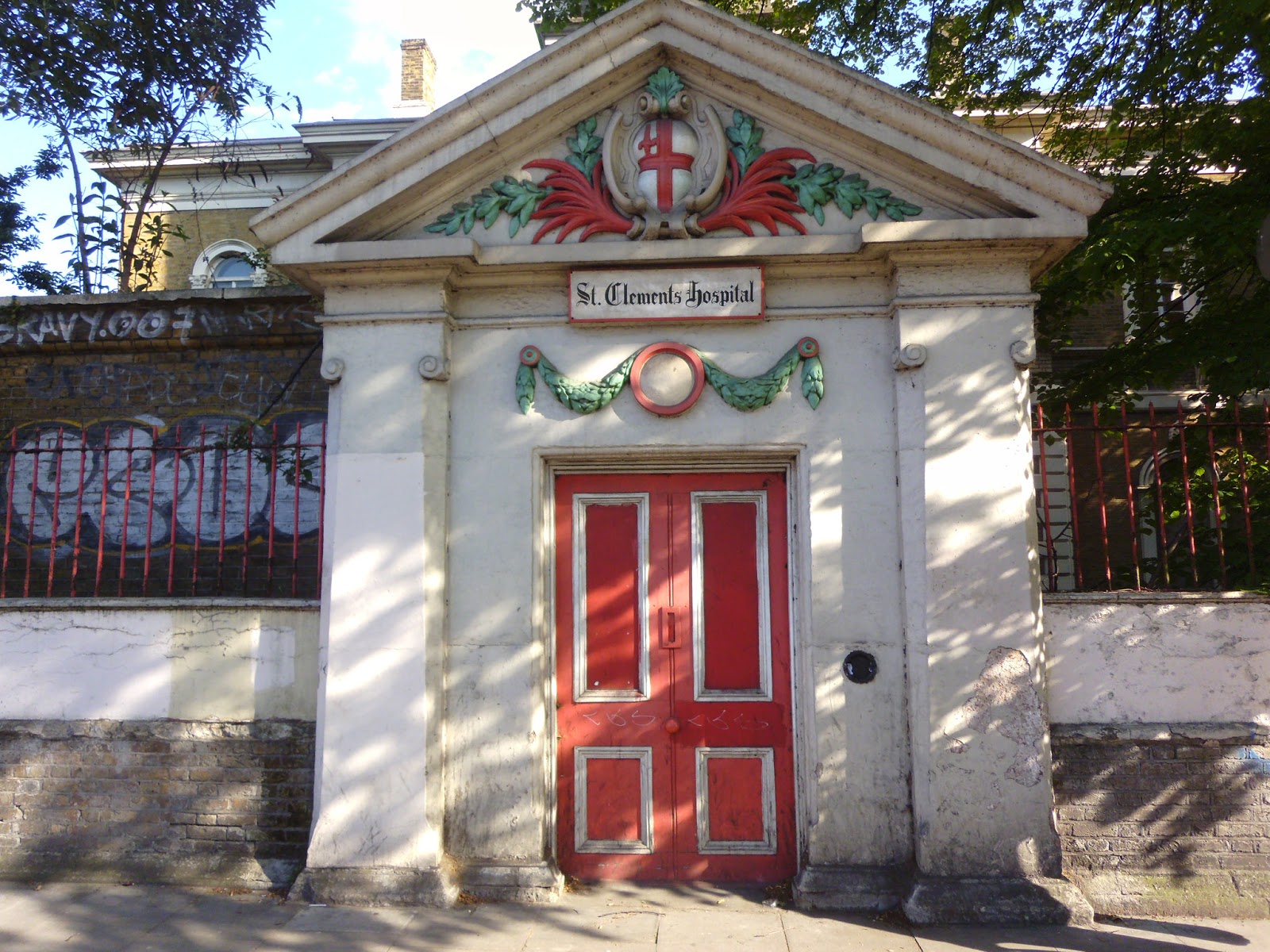
St Clements Hospital- vandals and nature have taken over the asylum.
| The old historic entrance to the hospital, the buildings behind have been vandalised. |
| Once much effort went to keeping people in, now the focus is on keeping unwelcome visitors out. |
When training to be a psychotherapist I undertook the mandatory psychiatric observation placement in Tower Hamlets, dividing time between a community mental health setting shadowing staff working at Stepney and Wapping Community Mental Health Team and time in the acute setting of St Clements, spending time with staff and patients on a rehabilitation ward. Conditions in the hospital were very antiquated. The building felt very Dickensian, it was like stepping back in time. Locked fogged plastic windows added to the feelings of claustrophobia. Some patients had lived in the hospital for a very long time, and had become quite institutionalised.
| Nature appears to be reclaiming the space, here ivy creeps over wrought iron railings. |
East London and The City Mental Health NHS Trust sold St Clements to the Homes & Communities agency, they plan to build 275 new dwellings on the site.
Tuesday, 2 July 2013
Brene Brown: the power and the beauty of vulnerability.
A friend sent me this link (highlighted below) to a talk on vulnerability by Brene Brown. Its one of 1,400 'creative commons' talks available on the TED website. TED for those who are not familiar with it was originally a conference held in the US- 'Technology, Entertainment, Design'. It's evolved and is now a major disseminator of ideas on the web.
These kinds of inspirational talks are something of an acquired taste, but this one touched me. Brown talks candidly about her life as a researcher, her attachment to the 'measuring stick', her research on shame, her psychotherapy and experience of breakdown/spiritual awakening. Its an uplifting talk though she doesn't explain how our need to defend and protect becomes so entrenched and habitual.
A funny, charismatic speaker, f you've ever struggled with vulnerability, experienced shame and fear loss of connection with others, you may find her talk interesting.
She names the main challenge-
Can we feel worthy of love and belonging?
Can we allow ourselves to be seen and be truly vulnerable?
Our vulnerability she reminds us is what makes us beautiful.
'Vulnerability is the birthplace of joy, creativity, belonging and love.'
Here's the link:
http://www.ted.com/talks/brene_brown_on_vulnerability.html
Friday, 31 May 2013
Jung on midlife: understanding the alchemy of life's midday. Don't dilly-dally on the way!
| Middle: 'Rush Hour' sculpture by George Segal, Broadgate, London. Top and bottom: Highgate Woods. |
At midlife we are confronted with a choice- to solidify ourselves and stay the same and live life as we've always lived it, following tried and tested character strategies and routines, or we can confront the existential givens of life, face reality as it is now and 'die into life'.
We die into life when we accept our time is running out; when we make peace with our past; when we honour our parents and ancestors ("Only that which has been properly separated can be rightfully joined"); when we follow our soul's call, letting go of cherished self-views of who we are and what we should be doing.
This 'nigredo' is a dark night, a time of depression and despair. There are deep feelings of loss and bereavement. Our old way is dying, decaying. It is also pregnant with exciting radical new possibilities. There's some sense of urgency. We know this. We need to focus. Times's been called.
Eventually messages emerge out of the decomposition-
Don't wait for others to make you happy, BE HAPPY, share your happiness, forget about taking -GIVE, or if you've always given TAKE! If you've always worked-play! If you've always played -work! Don't try and change others, allow the change in yourself, and then stand upright for what you believe in. Break your habits! Break the mould! Let lead become gold. Let the alchemy do its work...and don't dilly-dally on the way!
If we trust and hold steady, allowing old phoney self forms to die and wither away we emerge stronger, more authentic, enlivened and transformed. We escape the living death that undoes so many, and our winter paradoxically also becomes our spring.
I like the way Jung describes midlife:
'From the middle of life onward, only he remains alive who is ready to die with life. For in the secret hour of life's midday the parabola is reversed, death is born. The second half of life does not signify ascent, unfolding, increase, exuberance, but death, since the end is its goal. The negation of life's fulfillment is synonymous with the refusal to accept its ending. Both mean not wanting to live; not wanting to live is synonymous with not wanting to die. Waxing and waning make one curve.'
The Structured Dynamics of the Psyche
Thursday, 30 May 2013
Wisdom of heartbreak on the Underground Leyton
| Notice board at Leyton Underground Station. This quote made a change to the usual announcements about service delays. |
Things don't go wrong and
break your heart so you can
become bitter and give up.
They happen to break you down
and build you up so you can
be all that you were
intended to be.
Charles 'Tremendous' Jones
Subscribe to:
Posts (Atom)